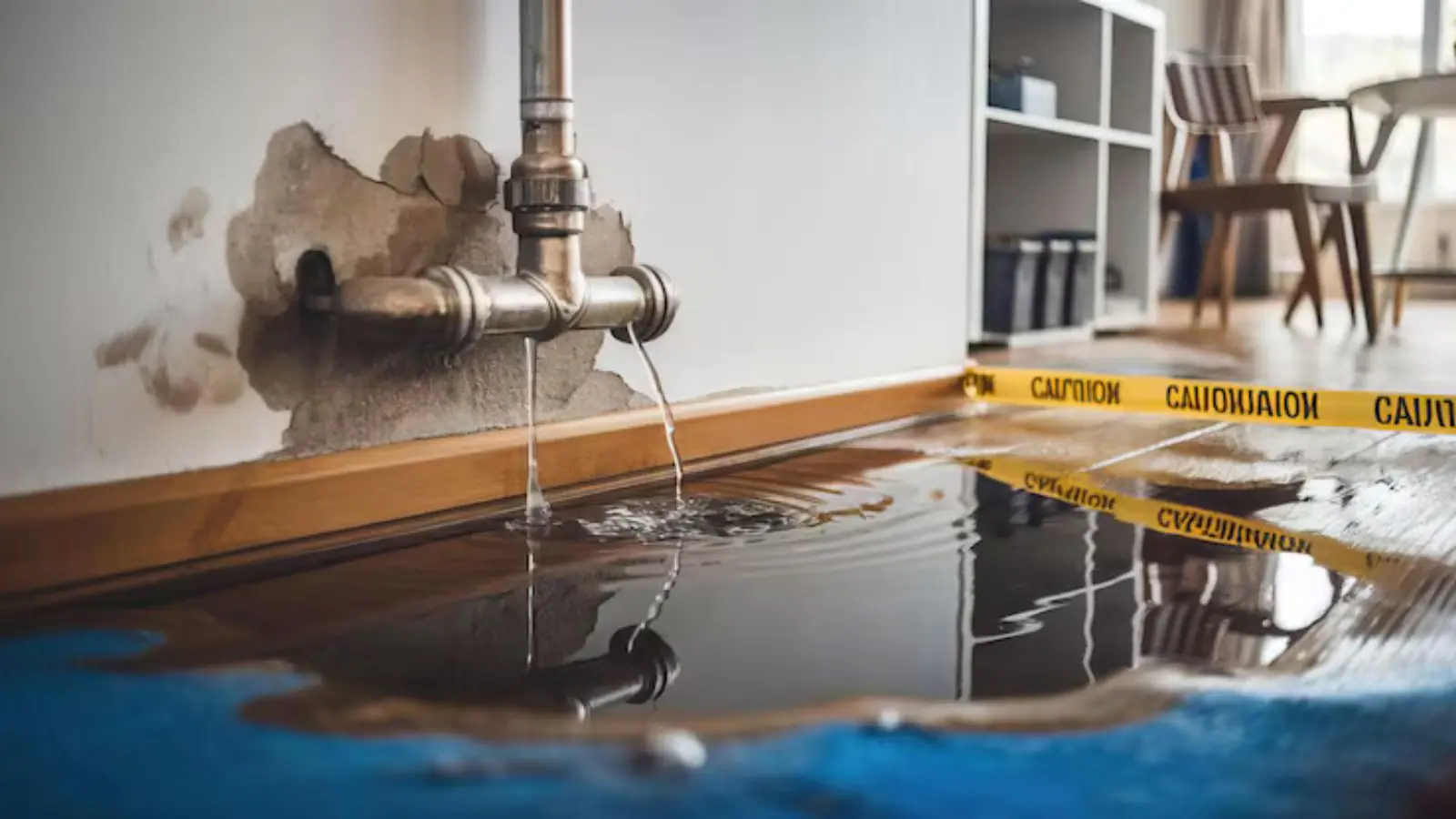
Water that has stopped running is not water that has stopped doing damage. If a pipe, appliance or roof has leaked in your Laguna Woods home, mitigation is the work that limits how far the damage goes. Our 24/7 line is open now, and calling the same day gives crews the most to save.
Water mitigation means stopping the loss and stabilizing the property in the first 24 to 72 hours. It covers shutting off the source, removing water, setting up air movers and dehumidifiers, and measuring moisture until the structure is dry. It is different from repair, which rebuilds what was lost.
Safety and preparation before work begins
What to do while mitigation is under way
- Leave air movers and dehumidifiers running and keep doors and windows closed so the equipment can work.
- Do not unplug or move equipment, and keep children and pets away from hoses and cords.
- Do not turn on ceiling fixtures under a wet ceiling, and stay out of rooms with sagging ceilings.
- Tell the crew about any new stain, odor or drip right away.
My wall is wet and my floor feels damp. What now?
Most people do not search for the word mitigation. They search for what they see: a stain that keeps growing, a baseboard that is swelling, carpet that squishes underfoot, a musty smell in a closet. Those are the signs that water is still inside the structure.
If you see any of them, you need two things. First, find and stop the source. Second, get the building dry, because the EPA says to dry water-damaged areas and items within 24 to 48 hours to prevent mold growth. That second job is mitigation, and it uses equipment you cannot buy at a hardware store.
When water damage is an emergency
Water inside a wall cavity
A leak behind drywall can wet insulation and framing without any visible puddle. Moisture meters find it, and a small opening lets air reach it.
Wet carpet and padding
Padding holds water and dries slowly. If it stays wet for more than a day or two, it is a candidate for removal.
A ceiling that is stained or sagging
A bulge means water is pooled above the drywall. Do not poke it. Call so the water can be released in a controlled way.
Wet cabinets and baseboards
Particleboard and trim swell when wet and may not return to shape, so early drying changes what can be saved.
How structural drying works
Drying is a measured process, not a guess. A crew records moisture readings in walls, floors and ceilings on day one, then sets equipment to pull moisture out and checks again each visit until the readings return to normal ranges for the materials.
Inspect and map
Moisture meters and thermal imaging locate wet materials, including areas that feel dry to the hand.
Remove what cannot dry
Soaked padding, saturated insulation or wet drywall may be removed so the rest can dry.
Set equipment
Air movers push dry air across surfaces and dehumidifiers pull moisture out of the air.
Monitor
Readings are checked on each visit. Equipment stays until the structure is dry, not for a fixed number of days.
Equipment, in plain words
Air movers are high-velocity fans that blow air across wet surfaces. Dehumidifiers, including low-grain refrigerant (LGR) models, remove water vapor so it cannot settle back into materials. Moisture meters read the water content of drywall, wood and concrete. Thermal cameras show temperature differences that point to damp areas.
Drying time varies. Many jobs take several days, and heavier materials such as hardwood or thick framing can take longer. We do not offer a flat number, because readings decide when the job is done. We also do not rent equipment for you to run on your own.
| Stage | Question it answers | Typical timing |
|---|---|---|
| Water removal | How do we get the standing water out? | Right away, first hours |
| Mitigation and drying | How do we stop the damage from spreading and dry the structure? | First 24 to 72 hours and until readings are normal |
| Cleanup | How do we remove debris and sanitize? | During and after drying |
| Repair | How do we rebuild what could not be saved? | After the structure is dry |
Wet materials drying out of reach?
Call the 24/7 line. Same-day response is offered when crews are available.
Structural drying in a stacked building
Laguna Woods Village has one-story and two-story buildings, and the Village's own bulletins refer to second- and third-floor manors. In any building with units above and below, drying has to account for neighbors. A leak that starts upstairs can soak a ceiling, run down a wall and wet the floor edge below, so readings are taken in each affected space.
Moisture also crosses shared walls. If your neighbor's side is wet, the mutual may need to coordinate access. Report the leak to Resident Services at 949-597-4600 and ask your mutual how it handles shared-wall drying.
Mutual rules differ. The Third and United mutuals each publish an insurance disclosure. Both say that when plumbing fails in your unit or a neighbor's, the owner's improvements and personal property are generally the owner's responsibility, and both mention a $100,000 master policy deductible. Read your own mutual's document and ask Resident Services before assuming.
What affects the cost of water mitigation
- Water category. Clean water is simpler to dry than gray or black water, which need removal and disinfection.
- Square footage and rooms. More wet area means more equipment and more monitoring.
- Materials. Concrete, hardwood and framing hold moisture longer than drywall or carpet.
- Days of drying. Readings decide when equipment comes out, so the number of days changes with the loss.
- Items that must be removed. Padding, insulation and drywall removal add labor and affect the rebuild.
Want your real number? Call (949) 670-0939. Scope and price are explained before work starts.
Insurance is worth a short, general note. California's Department of Insurance says homeowners policies do not cover flood damage but do cover other kinds of water damage, and coverage depends on the cause. Sudden and accidental water damage is often covered, while slow leaks and neglect often are not, and flood usually needs its own policy. Check your policy or ask your insurer, because we cannot promise how any claim will be decided.
Mitigation records, including readings and photos, are often what an adjuster asks for. We document the work, and you can pass that along to your insurer.
Where mitigation fits with other services
If water is still standing, emergency water removal comes first. After drying, water damage cleanup handles debris and sanitizing, and water damage repair rebuilds. For jobs in nearby cities, our Lake Forest page lists the ZIP codes we cover there.
If mold has already appeared, see mold remediation. EPA guidance says areas of about 10 square feet or less can often be handled by the household, and larger areas call for professional help.
Water mitigation service map for Laguna Woods
Common questions
Yes. Dispatch runs 24/7 and crews can be sent the same day when available. Call, describe what you see and follow the dispatcher's steps for stopping the source and protecting belongings while you wait.
It depends on the materials and how much water got in. Many jobs take several days. Moisture readings decide when drying is finished, not a calendar.
Fans move air across wet surfaces, but they do not remove the moisture from the room. Dehumidifiers pull water vapor out of the air so it cannot settle back into walls and floors.
No. Mitigation stops the spread and dries the structure. Repair rebuilds drywall, flooring, paint and trim afterward.
Quick drying lowers the risk, and the EPA ties the 24 to 48 hour window to preventing mold growth. No one can promise mold will never appear, which is why moisture readings matter.