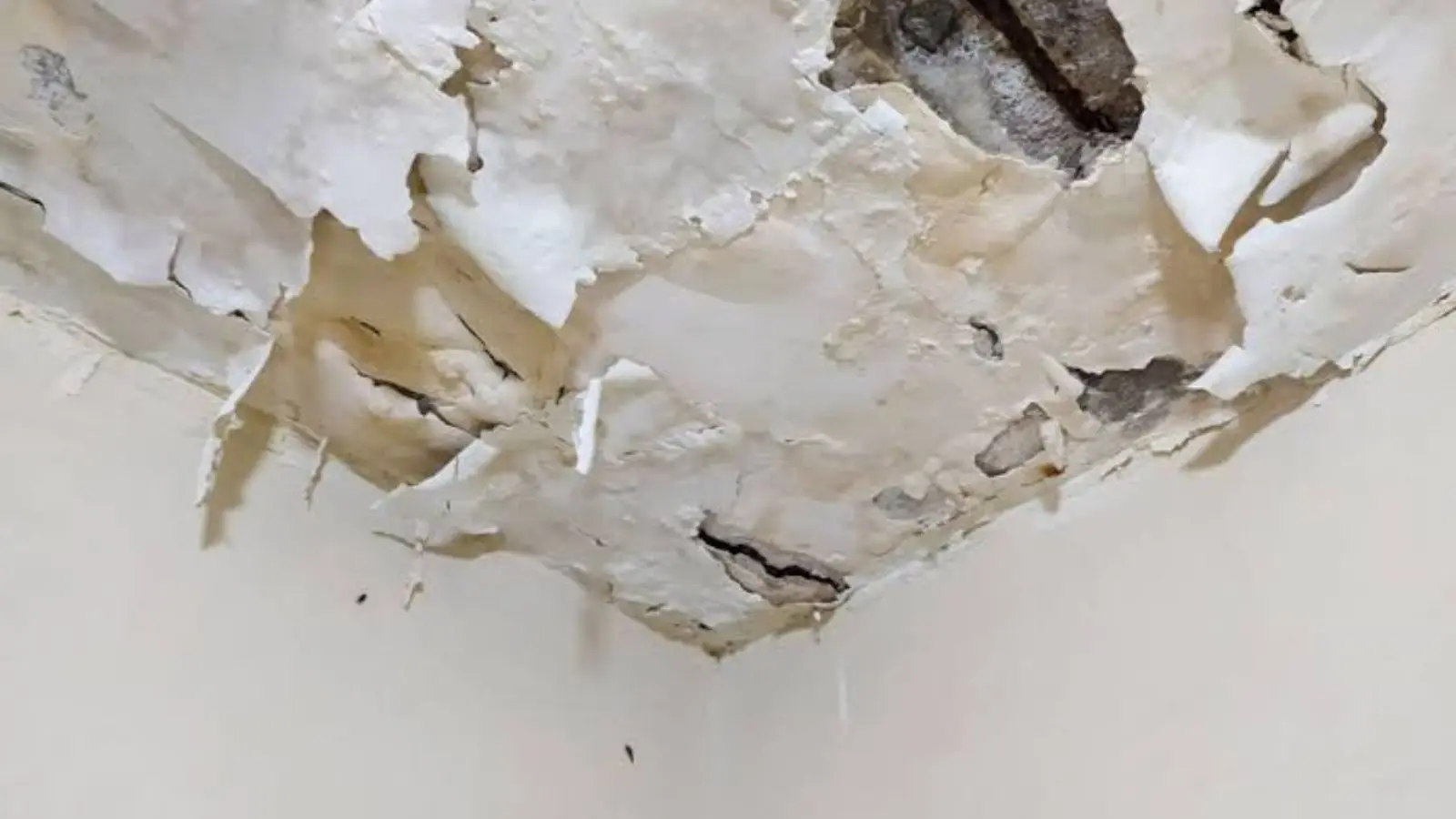
Water damage on a ceiling shows up as discoloration, texture changes or movement in the surface, and it means moisture has reached the drywall or plaster from above. In Laguna Woods, CA, where many homes sit under other homes, the cause is often not on your side of the ceiling.
This guide is about reading the evidence and deciding how urgent it is. It does not cover how to repair anything, since that depends on what you find.
What the marks on your ceiling are telling you
Yellow or tan patch
Often a first, thin wetting. The stain can be old and dry or it can be spreading, so mark its edge and watch it.
Brown ring with a darker edge
Rings form when a stain dries and gets wetted again, and each wetting adds a ring. A ring means the leak repeats.
Bubbling or peeling paint
Water is pushing the paint film off the surface. The drywall behind it is likely wet.
Sagging or bowing
The board is saturated and heavy. This is the sign that carries the most risk of a sudden release.
Active drip
Water is moving right now. Place a bucket, protect belongings and find the shutoff.
Dark spots or fuzzy growth
The FEMA mold brochure treats discolored walls and ceilings as a first thing to check, and CDPH says moisture is the main factor behind indoor mold.
Color alone cannot tell you the cause or the age. A pale stain can sit over a ceiling that is still soaking wet, and a dark one can be long dry. Touch and a moisture reading are what separate the two.
Where ceiling water comes from in a stacked building
Many Village buildings have more than one floor, and a two- or three-story building puts one home's floor over another home's ceiling. That layout changes the list of suspects.
Plumbing above
Supply lines, washing machine hoses, dishwasher connections and toilet seals in the unit overhead can all release water into your ceiling.
Water heaters
Tank failures and relief valve discharge are a known source in older buildings. A tank near an upper floor can wet the ceiling below.
HVAC condensate
Air handler drain lines can clog, and the overflow pan then spills into the ceiling beneath the unit.
Roof and flashing
Rain can enter at a worn seam or vent flashing and travel along framing before it drips somewhere else.
Bath and shower leaks
Failed grout, a cracked pan or a loose drain can leak slowly for months before a stain appears.
Rain is a smaller part of the Southern California picture than people expect. NOAA's 1991 to 2020 normals for the nearest long-record station, Santa Ana John Wayne Airport, show about 11 inches a year, mostly in January, February and December. A stain that appears in July therefore points away from the roof and toward plumbing or condensate.
How urgent is it? A ladder you can use today
| What you see | What it suggests | How soon to act |
|---|---|---|
| Active drip or running water | A live leak | Now. Stop the source and call for help. |
| Sagging or bowed drywall | Saturated board | Now. Keep people out from under it. |
| Bubbling paint, damp to the touch | Recent or ongoing wetting | Same day. Document and get readings. |
| Fresh brown stain, edges soft | A leak within days | Within a day. Look for the source. |
| Dry ring, no growth, no change in a week | An old, finished leak | Schedule an assessment. Watch for change. |
| Dark spots or a musty smell | Long-term moisture | Soon. Moisture first, then a professional look. |
Why the stain is rarely right below the leak
Water follows gravity along the easiest path. It runs down a pipe, across the top of a joist or along the back of a board, and it drops where something stops it.
That means the stain can sit several feet from the true source. If you draw a circle around the mark and look straight up, you may miss the pipe entirely. A moisture map from the ceiling, and a look at the plumbing path above, will show where the water traveled.
Condensate lines are an easy one to overlook. They carry water away from an air handler, and when algae or debris clogs the line, the pan above overflows slowly. A stain that grows in warm months and sits near a closet or hallway ceiling is a clue worth following.
Seeing more than one of these?
Call and describe what you see. A crew can map the moisture before any wall or ceiling is opened.
What to write down before anyone touches it
A documentation checklist
- Take photos in daylight with a ruler or coin in frame, and repeat every few hours if the stain changes.
- Trace the edge of the stain in pencil and date it.
- Note the date, time and what you were doing when you first saw it, and whether any appliance upstairs was running.
- Keep a log of every call, who you spoke to and what they said. The California Department of Insurance recommends this, along with keeping receipts.
- Save the damaged materials if you can, until an adjuster has seen them.
Careful records protect you whichever way the cause turns out. They also help a restoration crew decide where to look, and they speed up any insurance conversation.
If you suspect mold, the CDC does not recommend testing to identify the type, and CDPH says any mold you see or smell should be dealt with. Health questions belong with a physician.
For the next stage, water damage repair covers the rebuild once the structure is dry, and water mitigation handles the drying. We also serve nearby homes in Lake Forest and Mission Viejo.
Stacked homes in Laguna Woods Village
Laguna Woods Village runs on three kinds of housing corporation. Third Laguna Hills Mutual is a condominium, United Laguna Woods Mutual is a stock cooperative, and Laguna Woods Mutual No. Fifty, known as the Towers, is a self-managed condominium with two high-rise buildings. Each has its own rules about who handles a ceiling leak.
Because the three differ, the right first call depends on your building. Resident Services at 949-597-4600 is the Village number published for leaks in manors, so start there to report a ceiling problem, then read your own mutual's insurance disclosure.
Source type: community association document
A short insurance note. Claims turn on the cause, and the California Department of Insurance says sudden and accidental water damage is typically covered while seepage and slow leaks are generally not. Photos and dates help show which one you had. Check your policy and ask your insurer.
Common questions
It usually means water has soaked the area, dried, and been wetted again. Each cycle can add a ring. Repeating rings suggest the source is still active.
No. An active drip or a sagging ceiling is urgent. A dry, old ring that has not changed in a week is not, though it still deserves an assessment.
Yes, but plumbing and condensate lines are more common sources in stacked buildings. A stain that appears in a dry month points away from rain.
Photograph the stain, trace its edge, log the date and time, and keep receipts. Then report it to Resident Services at 949-597-4600 and to your own insurer. Third Laguna Hills Mutual's published policy, as one example, tells owners to contact their own insurer. Other mutuals differ, so check yours.
The CDC does not recommend mold testing, and CDPH says knowing the type does not change what you should do. Find and fix the moisture, and ask a physician about any health concerns.