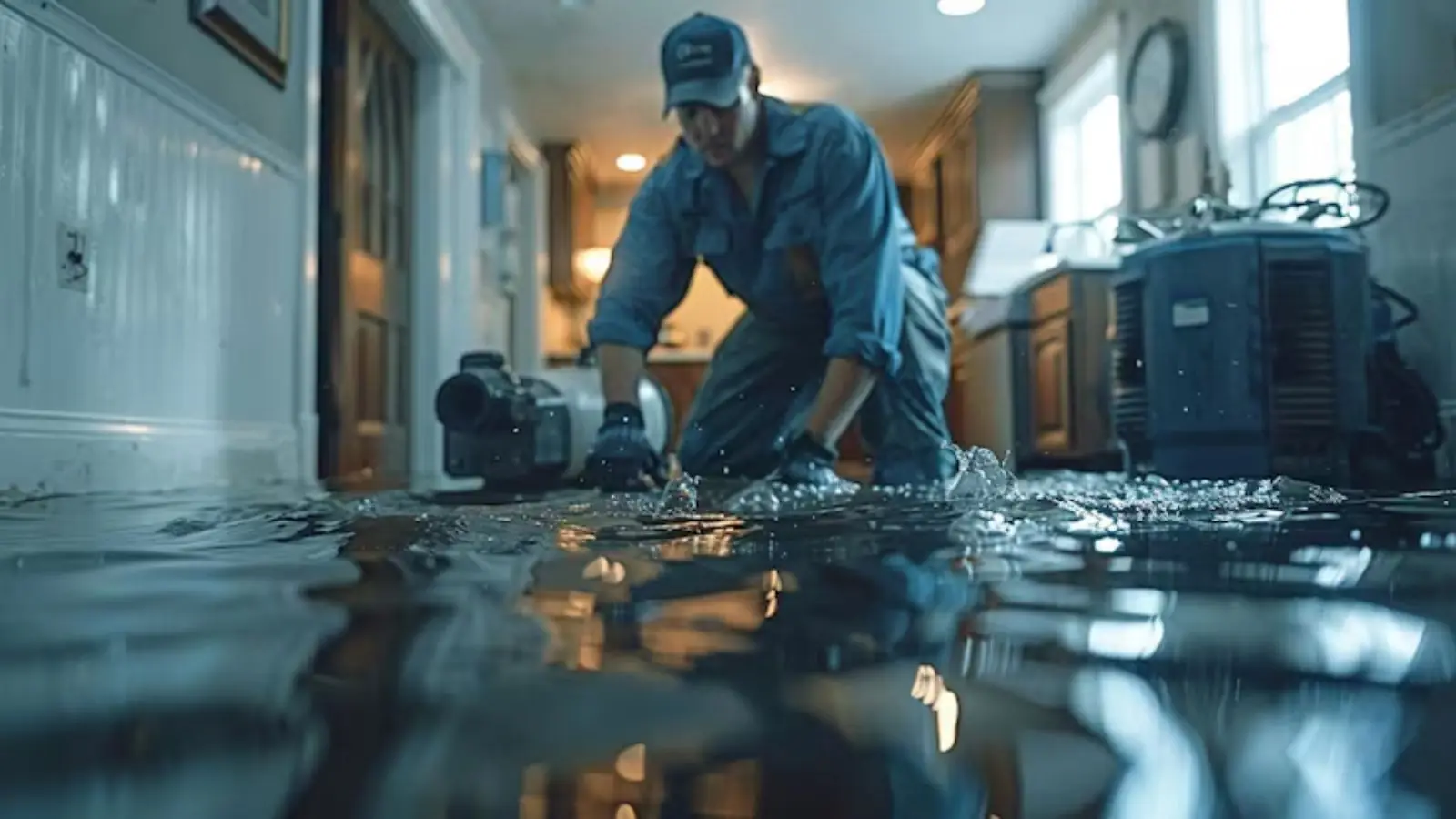
A water damage insurance claim is your written request that your insurer pay for a covered loss, and in Laguna Woods, CA it starts the moment you find water. What you do in the first day shapes how smoothly everything after goes. This guide follows the order the California Department of Insurance (CDI) recommends.
We document restoration work, including photos, moisture readings and written scopes, but we cannot promise how a claim will be decided. That call belongs to your insurer and your policy.
The claim in eight steps
Stop the source
Shut off the water at the fixture, unit valve or main. The CDI says to stop the leak at its source and dry wet areas, because policies expect reasonable steps to prevent more damage.
Report promptly
Tell your insurer or agent right away. Ask for a claim number and write down the date, time and name of whoever you spoke with.
Photograph before you move anything
Take wide and close photos and a short video of the damage, the source and damaged belongings. Do this before cleanup.
Mitigate and keep receipts
Temporary measures to limit damage, such as extraction and drying, are expected. Keep every receipt for protection costs.
Start a claim diary
Log every call, email and visit. The CDI recommends keeping a diary and copies of all correspondence.
Hold off on permanent repairs
Avoid permanent repairs until the adjuster has inspected, so the damage can be seen as it is.
Get written bids
The CDI suggests written bids from licensed contractors, and at least one repair estimate helps you compare against the insurer's figures.
Review the decision
Read the acceptance or denial in full. If you disagree, ask the adjuster to name the specific policy provision behind it.
If you suspect mold after a leak, the CDI advises contacting your claims adjuster immediately and not cleaning it up yourself first. Mold is often excluded, but the adjuster should see what you found. The policy and any mold endorsement will answer the rest.
California's clock for insurers
California's Fair Claims Settlement Practices Regulations (10 CCR section 2695.1 and following) set deadlines for insurers. The table lists the main ones as the CDI publishes them. Deadlines count calendar days, and an insurer may ask for more time with written notice.
| Stage | What the rule says | Time limit |
|---|---|---|
| Acknowledge | Insurer acknowledges the claim and begins investigating (2695.5) | Within 15 calendar days |
| Decide | Insurer accepts or denies after receiving proof of claim (2695.7(b)) | Within 40 calendar days after proof of claim |
| Explain a denial | A denial must be in writing with the reasons (2695.7(b)) | With the denial |
| Keep you informed | If more time is needed, written status notices follow (2695.7(c)) | Every 30 days |
| Pay | Insurer pays once the claim is accepted (2695.7(h)) | Within 30 calendar days of acceptance |
Proof of claim means the documents the insurer reasonably needs, so quick, organized records can move the clock. If a deadline passes without word, call the insurer and write down what you were told. The CDI Consumer Hotline at 1-800-927-4357 takes complaints, and the CDI also offers a free mediation program for residential property claims. Ask the hotline if your dispute qualifies.
Need drying records for your claim?
Call the 24/7 line. We document readings, photos and scope as the work happens.
Laguna Woods Village: a ceiling leak from the unit above
Stacked buildings add a question the steps do not answer: whose insurer responds when water comes from upstairs. In Laguna Woods Village that depends on your mutual.
Only Third's published Damage Restoration Policy was read for this post. It says the owner repairs damage to the unit and pays the unit deductible by default. The mutual repairs common areas and pays the insurance deductible when the source of damage is exterior to the manor, and the policy tells owners to always contact their own insurer.
For some causes, the policy says responsibility depends on the facts. That is a reason to report the leak to Resident Services at 949-597-4600 the same day and to call your own insurer as well. A short email to both, with photos, creates a dated record. This is a decision map, not a legal conclusion, so confirm with your mutual and insurer.
Source type: community association damage restoration policy and state insurance guidance
Records an adjuster can use
Keep a single folder, paper or digital, for the whole claim. Put in the claim number, the photos with dates, every receipt and a one-page timeline of what happened and when. If you can, store a copy somewhere that does not depend on the damaged home.
Ask your restoration crew for the written scope, the moisture readings and the photos taken on each visit. Moisture logs show that drying was real work with a measured end, not a guess. Send these to the adjuster as they come, and note the date you sent them.
Be careful with belongings. List items before you throw them out, photograph them and keep samples of flooring or carpet when the adjuster asks. If something is a health or safety hazard, such as sewage-soaked material, tell the adjuster before it leaves the home.
Who to call first on a shared ceiling
A quick map for an upstairs leak
- Source still running: shut it off if you can reach the valve, or ask Resident Services for help.
- Your own insurer: report the loss and open a claim, whoever turns out to be responsible.
- Resident Services: report the leak and ask how your mutual handles the source and the common area repair.
- The neighbor above: share what you know and keep notes, but leave blame to the insurers.
- A restoration crew: drying should not wait for the paperwork, since the EPA advises drying within 24 to 48 hours.
Common claim mistakes
The most common error is waiting. A stain that looked minor on Monday can be a swollen wall by Friday, and a late report invites questions about whether the damage could have been limited. The second is throwing away evidence before it is photographed.
A third is agreeing to a settlement figure before the full scope is known, since hidden moisture often shows up once drying begins. Ask the adjuster how a later discovery would be handled, and put the question in writing.
Where restoration fits
Restoration work often runs alongside the claim. Emergency water removal comes first when water stands, and water damage repair follows once the structure is dry. Many insurers ask for itemized records, so ask any crew for a written scope and photos before they leave.
If you are weighing options, compare nearby service areas too. Our pages for Lake Forest and Laguna Beach list the ZIP codes we cover next door.
Common questions
As soon as you find the damage. The CDI says to report your loss to your agent or insurer right away, take reasonable steps to prevent more damage and keep receipts. Waiting can complicate the claim because later damage may be treated as avoidable.
Under 10 CCR 2695.5 the insurer must acknowledge the claim within 15 calendar days. Under 2695.7 it must accept or deny within 40 calendar days after proof of claim and pay within 30 calendar days of acceptance. A denial must be written.
Make temporary repairs and dry the area, and keep receipts. The CDI advises avoiding permanent repairs until the adjuster has inspected. Photograph everything before it is removed.
Read the written reasons and ask the adjuster to name the policy provision. You can call the CDI Consumer Hotline at 1-800-927-4357, and the CDI offers a free mediation program for residential property claims.
It depends on the cause, your policy and your mutual's rules. Third's published policy says owners should contact their own insurer, the owner pays the unit deductible by default, and the mutual pays the deductible when the source is exterior to the manor. Other mutuals may differ, so ask Resident Services at 949-597-4600.