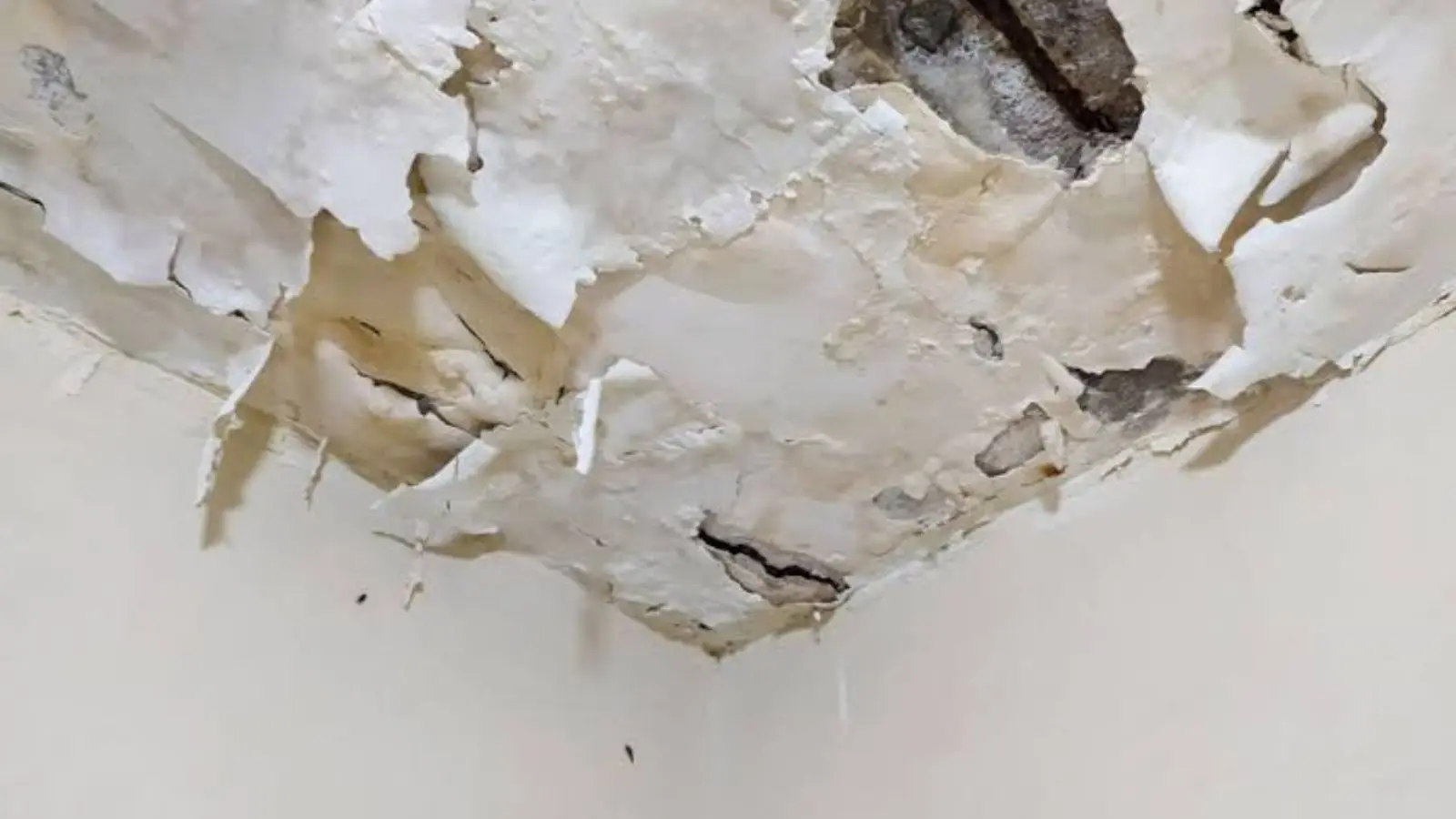
Water damage to a ceiling is stained, softened or sagging drywall or plaster caused by a leak from above. If you are reading this in Laguna Woods, CA with a brown patch overhead, the repair follows a fixed order, and skipping a step is how stains come back.
The order is simple to say and easy to get wrong in practice. You stop the water, confirm the material is dry, remove what is ruined, patch, texture and paint. Most of the failures people report come from painting too early.
Before you touch the ceiling
Start with the water source, not the stain. A ceiling stain is only the place where water finally showed itself, and the actual leak can sit several feet away along a joist or pipe run.
If the leak is active, shut off the nearest stop valve, or the main shutoff if you cannot tell. Move furniture out from under it, put a bucket in place and photograph everything before you change anything. The California Department of Insurance advises stopping the leak at its source, drying wet areas and keeping receipts for what you spend protecting the home.
Safety checks before you reach up
- Turn off power to any light fixture or fan in the wet area. Water inside a ceiling box is a shock risk.
- Do not poke a bulging ceiling from directly underneath. Trapped water can release all at once, so puncture it only from the side, into a bucket, with eye protection.
- Wear a dust mask and gloves when you cut or scrape, because old paint and drywall dust are not things to breathe.
- If the water is dark, smells like sewage or came from a drain line, stop. That water needs professional handling.
Step by step: how to fix the ceiling
Stop the source
Repair or isolate the leak. A patch over an active leak fails within weeks.
Check whether it is still wet
Press the area with a gloved hand. Soft, cool or cold surfaces are still holding water. A moisture meter gives a number, and a pro's thermal camera shows wet areas you cannot see.
Cut out what is ruined
Remove drywall that is soft, crumbling or sagging. Cut a clean rectangle back to the joists so the new piece has something to screw into.
Dry the cavity
Run a fan and a dehumidifier for several days. The EPA says to dry water-damaged areas within 24 to 48 hours, and FEMA notes rebuilding usually waits two to three days after drying starts.
Patch
Screw in a drywall piece the same thickness, tape the seams and apply joint compound in thin coats. Sand between coats.
Texture
Match the existing finish, whether it is knockdown, orange peel or acoustic popcorn. Practice on cardboard first.
Prime and paint
Seal the area with a stain-blocking primer, then paint the whole ceiling plane to the nearest corner so the repair does not show.
Step two deserves the most patience. A ceiling that feels dry on the surface can still hold moisture in the insulation above it, and sealing that in invites mold. The EPA is direct that you should not paint over mold, and that mold control comes down to moisture control.
What to cut out and what to keep
Discolored but firm drywall
If it is hard, flat and fully dry, it can often be sealed with stain-blocking primer and painted without cutting.
Soft, sagging or bubbled drywall
Cut it out. Wet gypsum loses its strength and will not hold a screw or tape.
Wet insulation above
Fiberglass that has soaked loses much of its value and holds water against the board. Remove and replace it.
Ceiling tiles or acoustic texture
The EPA notes that ceiling tiles and other porous materials may have to be thrown away if they become moldy.
Not sure how far it spread?
Describe the stain to the dispatcher. A crew can check with moisture meters before you cut.
When the job stops being a weekend fix
A small, dry, one-time stain is a fair DIY job. The picture changes when the problem is bigger than it looks.
Call for help if the ceiling covers more than roughly a few feet across, if it has sagged, if the stain has returned after a repair, or if you see or smell mold. The EPA suggests that mold covering more than about 10 square feet is a job for a professional, as is anything involving sewage.
If the leak came from a supply line in the unit above, emergency water removal and water mitigation come first, because the cavity must be dry before repair starts.
Once the structure is dry, water damage repair handles the cut-out, patch, texture and paint as one scope. For homes near our service area boundaries, the same process applies in Laguna Hills and Aliso Viejo.
Plan for the paint too. Ceilings are the hardest surface to blend, because light rakes across them and shows every edge. A flat ceiling paint, two thin coats and a wet edge kept moving across the whole plane give the best result.
Hiring is its own step. In California, you can check a contractor's license at the CSLB site or by calling (800) 321-2752, and the license number belongs on every bid and contract.
Ceiling leaks in Laguna Woods Village
Laguna Woods Village was built in phases between 1963 and 1985, and it holds 12,736 homes, according to the Village's own community information. Many buildings are therefore more than 40 years old, so original supply lines, water heaters and drain connections are common sources of leaks. Ask your plumber or Resident Services what is known about the plumbing in your building.
Village homes are called manors, and some buildings have second and third floors. If the stain sits under another unit, the source may be in a home you cannot enter. Report it to Resident Services at 949-597-4600, then tell your own insurer, because the question of who repairs what depends on your mutual's rules.
Source type: community association document and city website
A word on cost and insurance. The price of a ceiling repair depends on how much drywall comes out, whether insulation was wet, the texture to be matched and the paint area. No honest page can give you a number without seeing it.
Coverage depends on the cause. The California Department of Insurance says homeowners policies do not cover flood but do cover other kinds of water damage, and sudden leaks are treated differently than slow ones. Report the loss promptly, keep your photos and ask your insurer what applies.
Common questions
A small, completely dry stain, yes. A ceiling that is soft, sagging, larger than a few feet, or tied to a leak you have not found is a different job. Get it assessed before you cut.
The EPA says to dry water-damaged areas within 24 to 48 hours, and FEMA notes that rebuilding usually follows two to three days of drying. Let readings, not the calendar, tell you when it is ready.
Only if the source is fixed and the material is fully dry. Use a stain-blocking primer. Do not paint over mold, because the EPA advises cleaning and drying first.
Call Resident Services at 949-597-4600 to report the leak, and call your own insurer right away. As one example, Third Laguna Hills Mutual's published restoration policy says owners should always contact their own insurer, and it describes the Mutual repairing common areas. Mutuals differ, so check your own mutual's documents and policy.
Usually because the leak is still active, the insulation above stayed wet, or the primer was skipped. Brown rings that reappear after dry weather point to moisture still moving through the cavity.