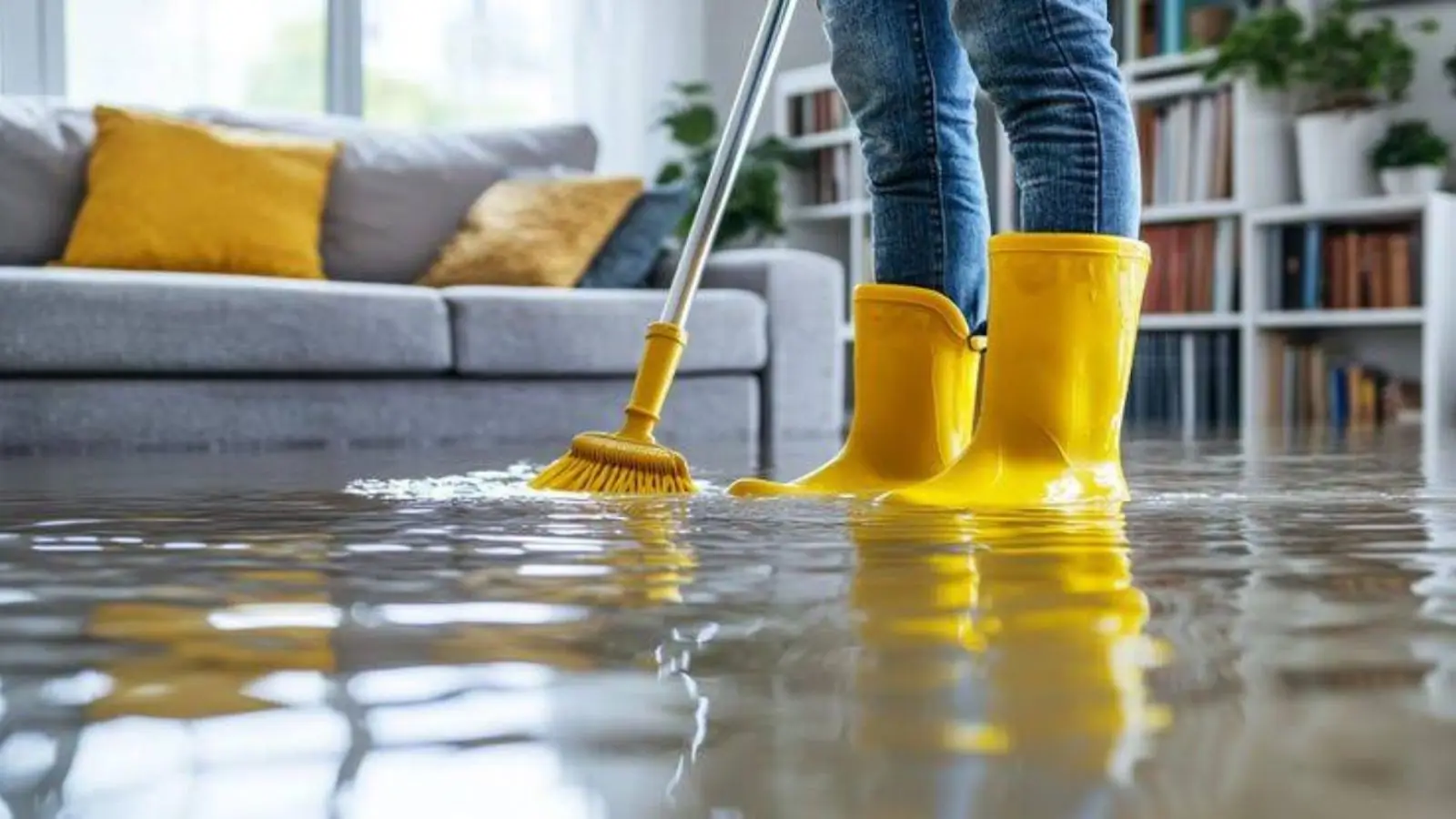
Laminate floor water damage is swelling, lifting or separation of planks after the board inside absorbs water. If your floor in Laguna Woods, CA is peaking at the seams or crunching underfoot after a leak, the clock is already running.
Laminate is a layered product. A photographic top layer sits on a core of compressed wood fibers, according to NALFA, the laminate flooring trade association, and a backing layer sits underneath. The top layer shrugs off a spill, but the core does not.
What water does to a laminate plank
Water finds the seam, not the surface. It slips between planks, soaks the edge of the core and swells it, and the swollen edge pushes up against its neighbor.
That pushing is what you see as peaking, where the joint rises into a ridge. Once the fibers have swelled, they rarely return to their original size, even after the plank dries. Surface wiping therefore saves only a floor that was wetted briefly.
Peaking at the seams
Edges swell and rise. Early peaking may flatten slightly if the plank dries fast, but often it does not.
Cupping or crowning
Planks curve because the underside is wetter than the top. This is a sign water is trapped below.
Buckling
Planks lift and arch off the subfloor. The floor has expanded with nowhere to go.
Soft or crumbly edges
The core has broken down. The plank cannot be dried back to its original strength.
What can be saved and what cannot
| Condition | Chance of saving | What usually happens |
|---|---|---|
| Spill wiped within minutes, seams tight | Good | Dry the surface and edges, and watch for swelling. |
| Water sat a few hours, edges starting to lift | Uncertain | Dry quickly, then see if planks settle. Some may need replacing. |
| Water sat a day or more | Poor | Swollen cores rarely recover. Plan to replace the affected area. |
| Buckled across the room | Very poor | Remove the floor, dry the subfloor and replace. |
| Dirty or sewage water | None | Porous materials contaminated this way are discarded. |
A key detail is the layer below. Laminate usually floats over a foam underlayment, and that pad and the subfloor can stay wet long after the top feels dry. A floor that looks recovered can still hold water underneath, so ask for a moisture reading before you accept it.
Floor lifting right now?
Call and tell the dispatcher what you see. Drying sooner means more planks to save.
The first 24 to 48 hours
Stop the water
Shut off the source and clear standing water with a wet-dry vacuum rated for liquids.
Remove furniture and rugs
Anything standing on the floor can stain it and trap moisture.
Run air and dehumidification
The EPA advises drying water-damaged areas and items within 24 to 48 hours to prevent mold growth.
Lift the baseboards
This frees the edge, giving swelling planks room and letting air under the floor.
Pull a plank or two if needed
Checking the pad and subfloor tells you if water got under. A crew can do this with meters.
Document everything
Photograph the damage and keep receipts. Do not throw out materials before the adjuster has seen them.
Do not use heat guns or aim heaters at the floor. Fast, uneven drying can warp planks further. Steady air movement and lower humidity are gentler. The EPA also suggests keeping indoor humidity below 60 percent, and ideally between 30 and 50 percent.
Checking the subfloor and the room around the planks
The planks are the visible part of a larger system. Under them sit a foam or felt underlayment, a vapor barrier in some installs and then the subfloor, which may be concrete slab or wood.
A wet floor can also wet the bottom of the wall. Water wicks into drywall and baseboards, so check the lower few inches of nearby walls and any cabinets that sit on the floor. NALFA also notes that concrete over soil needs moisture attention, which matters for ground-floor homes on a slab.
Ask the installer for the product name and batch from the leftover boxes or the original paperwork. Many owners keep a spare box in a closet, and that spare can make a repair possible years later. Without it, a flooring store can often match the look but rarely the exact gloss.
Replacement is its own decision. Laminate lines are discontinued often, so a few new planks may not match the old color or texture. If the floor is continuous through several rooms, a crew may suggest replacing to a natural break, such as a doorway, so the seam looks planned.
Waterproof laminate is a label to read, not assume
Some products are sold as water-resistant or waterproof, and the terms are not interchangeable. As NALFA says laminate is not suited to areas with excessive moisture, such as bathrooms, unless the manufacturer specifies it as waterproof, so the maker's label is the deciding word.
If you installed a product with that rating, check the maker's written instructions for how long standing water is tolerated. If you cannot find the rating in writing, treat the floor as standard laminate. For the repair stage after drying, see water damage repair, and for the first hours, water damage cleanup and emergency water removal describe what crews do.
We also serve homes close by in Aliso Viejo and Mission Viejo.
Whose floor is it? Flooring losses in the Village
Laguna Woods Village has three kinds of housing corporation, and the rules for interior finishes differ. Third Laguna Hills Mutual is a condominium, United Laguna Woods Mutual is a stock cooperative and the Towers, Mutual No. Fifty, is a condominium. Third and United both publish insurance disclosures saying that the Mutual's master policy and the owner's own policy split responsibility, and that owners should look at their own coverage.
In practice, that means you should read your mutual's disclosure before you start tearing out floor. Call Resident Services at 949-597-4600 to report a leak from above, and ask your insurer if your policy picks up flooring.
Source type: community association document
Keep the damaged planks until your insurer has seen them, or at least photograph the edges up close. Swollen edges are the best evidence of how long the floor was wet, and an adjuster may ask for that detail when deciding what applies.
Cost depends on how much floor is affected, whether the underlayment and subfloor stayed wet, and whether the product is still sold, since mismatched planks are a common problem. We do not quote numbers on a web page.
Common questions
Sometimes, if it was wetted briefly and dried fast. The core is compressed wood fibers, and once they swell they often stay swollen. A floor that stayed wet a day or more is usually a replacement.
The EPA recommends drying water-damaged areas and items within 24 to 48 hours to prevent mold growth. Remove standing water first, then move air and lower humidity.
Only if the manufacturer says so in writing for your product. NALFA notes laminate is not suited to excessive moisture unless specified as waterproof by the manufacturer.
The California Department of Insurance says a condo unit-owner policy generally covers the interior of the unit, while the association usually insures the building structure and common areas. Whether flooring counts depends on your policy and your mutual's documents, so verify both and report the leak to Resident Services at 949-597-4600.
Not always. A crew can use moisture readings to decide how much comes up. If planks buckled across a large area, a full removal is more likely.