Plainly: true basements are rare in Laguna Woods, CA. The community is made of manors and condominiums, mostly on slabs or raised foundations. So the closest thing to a basement is a lower level. Think of a garage, a storage room, a utility closet or a ground-floor room built on concrete.
Mold is a fungus that grows on any surface that stays damp, and it does not care what floor it is on. The advice below is what you would follow for a basement, adjusted for the spaces you actually have.
Why low spaces grow mold
Lower spaces collect moisture in quiet ways. Concrete slabs hold water vapor, garages are opened and closed to outdoor air, and storage rooms are packed with cardboard that soaks up humidity. A utility closet may hold a water heater or a washer line that weeps for months before anyone looks.
Garages
Wet cars, damp tools and stacked boxes against a cold wall keep the air near the wall humid. Runoff under the door adds more.
Storage rooms
Cardboard, fabric and paper are porous. They take on moisture first and show growth first.
Utility closets
Water heaters, supply lines and drain fittings can seep. A closet with no airflow holds that moisture.
Ground-floor rooms on a slab
Moisture can rise through concrete. Furniture pushed flat to an outside wall blocks the air that would dry it.
Find the moisture before you scrub
The EPA says the key to mold control is moisture control. If you clean the growth and leave the damp source alone, the same patch tends to return. So the first job is detective work, and it takes a flashlight more than a sponge.
Look for a dripping fitting, a stained baseboard, water marks that line up with a downspout or a door that lets in rain. Feel the lower few inches of the wall. If the source is a plumbing leak, stop it, and for an ongoing leak or any standing water, emergency water removal is the first service to call.
Control the humidity
The EPA advises keeping indoor humidity below 60 percent, and ideally between 30 and 50 percent. A small hygrometer, the kind that reads relative humidity, costs little and tells you whether a closet or garage is staying in range. Check it on a few different days, because a reading taken after a rainy night can differ from one in a dry week.
If a room stays above the target, give it air. Open a door when the weather is dry, keep stored items a few inches off exterior walls and avoid piling cardboard on bare slab. A dehumidifier sized for the room can help, but it treats the symptom. The leak or seep still needs its own fix.
Cleaning mold off a hard surface
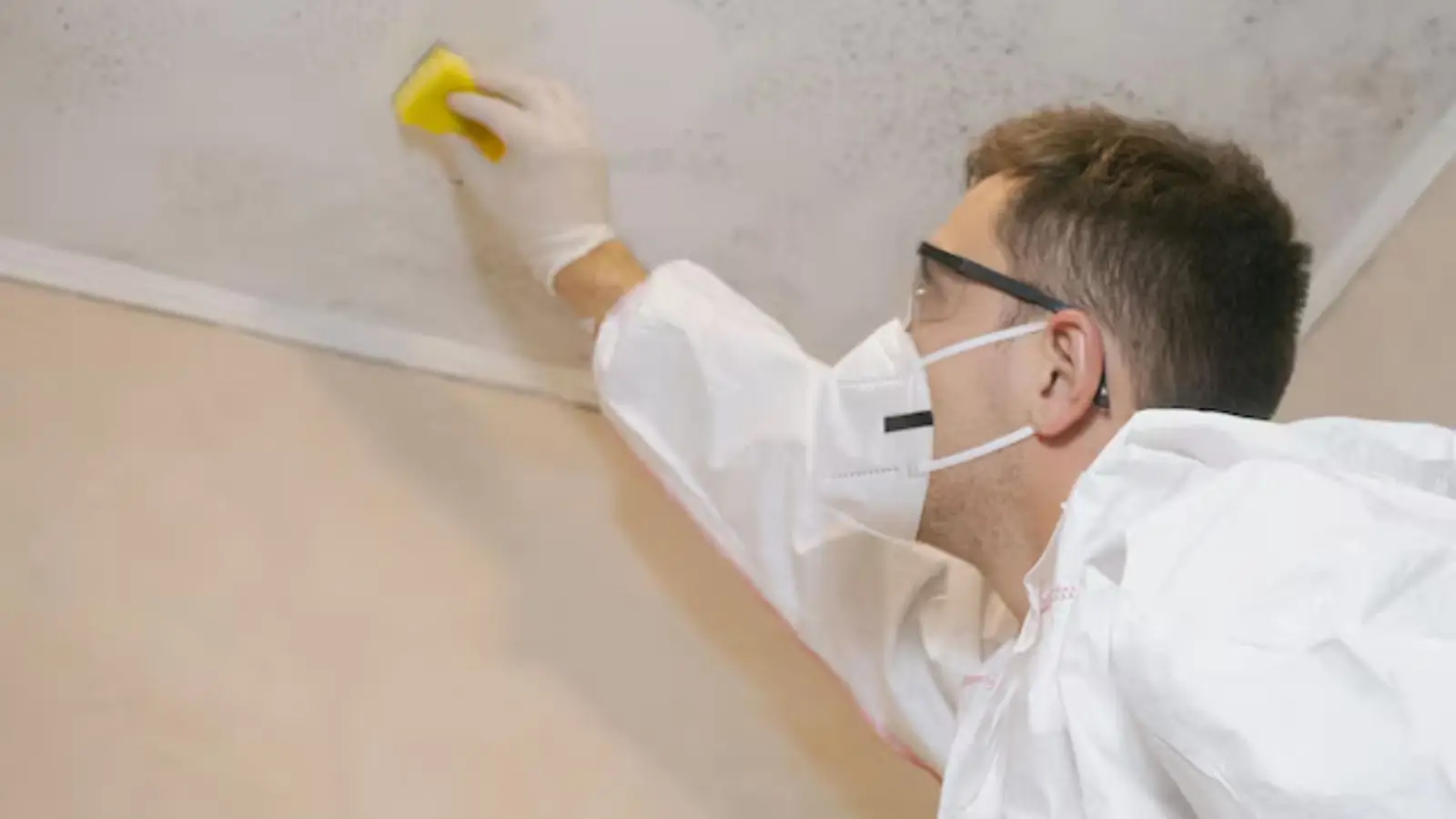
For a hard, non-porous surface such as sealed concrete, metal shelving, tile or a painted garage door, the EPA says to scrub mold off with detergent and water and then dry the area completely. The California Department of Public Health also points to soap and water for non-porous materials. Drying matters as much as scrubbing, because a damp surface invites regrowth.
Fix the source
Stop the leak or block the entry point first. Cleaning before that is wasted effort.
Scrub
Use detergent and water with a brush or cloth on hard surfaces. Rinse the cloth often.
Dry completely
Open the space, run a fan and let the surface dry. The EPA stresses complete drying.
Discard what is porous
Moldy cardboard, ceiling tile, carpet and similar absorbent items may have to be thrown away, according to the EPA.
Where the agencies disagree on bleach
Many people reach for bleach because it feels strong. The public agencies do not agree on it, so here are both positions side by side.
| Source | Position | What it means for you |
|---|---|---|
| CDC | Bleach can be used in limited amounts, up to 1 cup per gallon of water, and must never be mixed with ammonia | If you choose bleach, keep it diluted, ventilate and keep ammonia products out of reach |
| California Department of Public Health | Does not recommend bleach and calls it a respiratory hazard | Skip it, especially in a closed closet or garage with little airflow |
| EPA | Advises detergent and water on hard surfaces, then complete drying | This is the common ground between the agencies |
Because detergent and water satisfies all three, it is the simplest choice. Whichever you pick, do not mix cleaning products with each other. Mold also never gets fixed by covering it, so skip the paint. The EPA says not to paint or caulk over mold, since paint on a damp, moldy wall will peel and the growth stays underneath.
Not sure how far it goes?
Describe what you see to the 24/7 line and we will tell you whether it sounds like a job you can handle.
When to stop and call a professional
The EPA says areas of about 10 square feet or less, roughly a three-foot by three-foot patch, can often be handled by the household. It advises professional help when mold covers more than that, when the damage came from sewage or when a significant water event is behind it. Past that point, the work involves containment and removal of damaged materials, and mold remediation is the service built for it.
Wet drywall in a garage wall, a flooded closet or any rise in water from a storm drain should also move you toward a professional. The industry standard for that work is ANSI/IICRC S520, and you can ask a company whether its crews follow it. Health questions about mold exposure belong to your physician.
Lower-level mold in Laguna Woods Village
Village homes are called manors, and the Village describes one-story and two-story buildings built in phases between 1963 and 1985. Buildings that age have original slabs, walls and plumbing, so a slow seep in a utility closet or a weeping garage wall can go unnoticed for a long time. Check these spots each season and catch the damp early.
Resident Services at 949-597-4600 is the number the Village lists for leaks in manors. If the damp comes from a shared wall, a roof or a pipe that serves more than one unit, report it there before you pay for repairs. Mutuals differ, so ask what your own mutual expects.
Source type: community association document, city website
On cost, no honest number exists without seeing the space. What moves the price is the area affected, whether drywall or insulation has to come out and how long drying takes. The California Department of Insurance says mold is not usually covered by a homeowners policy and advises contacting your adjuster if you suspect mold after a leak. Check your policy before you scrub away evidence of a covered leak.
If the damp trouble began with a storm that pushed water under a garage door, our Laguna Hills and Mission Viejo pages show how crews handle the same problem in the neighboring cities.
Common questions
True basements are rare. Most Village manors are one- or two-story buildings, so the places that behave like basements are garages, storage rooms, utility closets and ground-floor rooms on concrete.
The EPA advises keeping indoor humidity below 60 percent, ideally between 30 and 50 percent. Mold still needs a wet surface, so fixing leaks matters as much as the number on the meter.
The agencies differ. The CDC says bleach can be used in limited amounts and never with ammonia, while the California Department of Public Health does not recommend it. Detergent and water is the option both can accept.
It depends on whether the space is yours or common property, and on your mutual's rules. Ask Resident Services at 949-597-4600 who is responsible for that specific space, and report any leak behind it.
The EPA says about 10 square feet or less can often be handled by the household. Larger areas, sewage damage or significant water damage call for a professional.