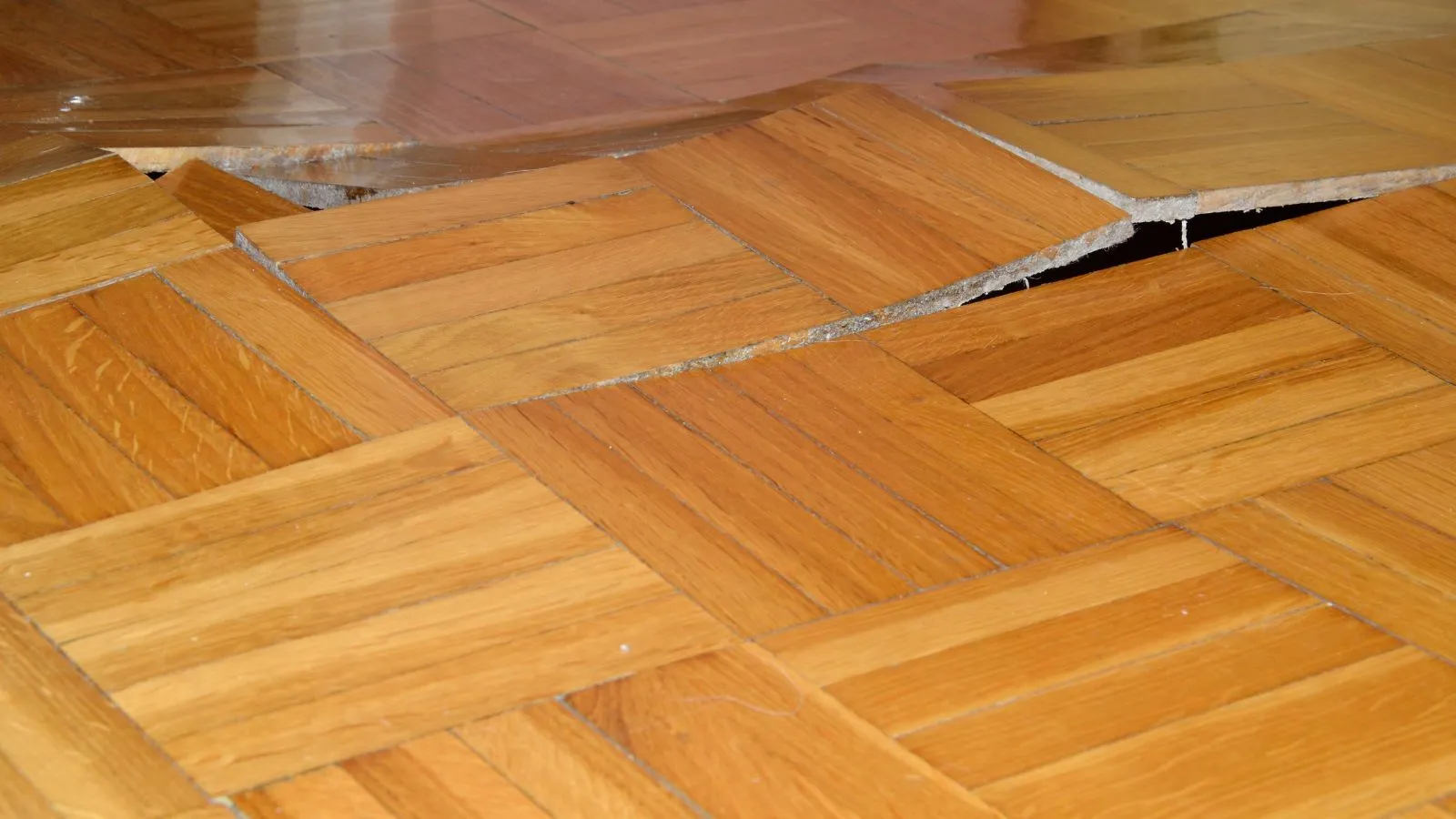
If your wood floor got wet in Laguna Woods, CA, the question is whether the boards can be dried where they lie or have moved too far to save. Hardwood floor water damage is moisture absorbed by solid or engineered wood flooring from a leak, overflow or spill, which makes the boards swell, cup, gap or stain. Our 24/7 line, (949) 670-0939, is open now, and a crew can be sent the same day when available.
Most floor damage in this area traces back to plumbing. A dishwasher hose, a water heater, a toilet supply line or a washing machine can put more water on a floor than a normal rain year does. The sooner the source is stopped and drying starts, the better the odds for the wood.
What your wet floor is telling you
Wood absorbs water through its edges and underside, then swells and changes shape. The shape it takes points to where the moisture sits and how long it has been there.
Cupping
The board edges rise higher than the center, so each plank looks like a shallow trough. It usually means more moisture under the floor than on top.
Crowning
The center of each board rides higher than the edges, which can happen when a cupped floor is sanded too early.
Buckling
Boards lift off the subfloor, sometimes in a ridge. NWFA guidance, published in Hardwood Floors magazine, says a buckled floor requires replacement wherever the buckling occurred.
Gaps
Gaps open between boards as wood dries and shrinks. Tight seams point to swelling that has not eased.
Dark staining
Gray or black marks in the grain usually mean water sat on the wood a while. Shallow ones can sand out.
Safety steps for the first hour
- Shut off the water at the fixture's stop valve or the main. If you cannot find it, call Resident Services at 949-597-4600 if you live in the Village.
- Keep power off in any room where water reached outlets or baseboard wiring. For sparks, a burning smell or any shock risk, call 911 first.
- Photograph the floor from several angles before anything is moved. Lift rugs, furniture legs and books off the wood so they do not stain it.
- Do not aim a heater or hair dryer at the boards. Fast surface heat can warp wood harder than slow drying does.
How we dry a wet hardwood floor
Find the moisture
Pin and pinless moisture meters read the boards, and a thermal camera flags damp zones that look dry. Readings are taken on the wood and, where possible, the subfloor.
Pull out surface water
Extraction wands lift standing water. Where the floor allows it, drying mats or panels connected to a vacuum system draw water up from the boards.
Give the floor air
Baseboards may come off so air can reach the edges. Air movers and dehumidifiers then dry the room, and in some cases air is pushed beneath the floor.
Track the readings
Each visit we re-measure. The floor is judged dry by its moisture content and the subfloor reading, not by how many days have passed.
Using mats and panels to dry wood in place is general industry practice. The National Wood Flooring Association has described vacuum mats and panels as one method, with airflow and dehumidification as another, and has noted that damage often fades as flooring dries over time.
Solid wood, engineered wood and what sits underneath
Solid hardwood is one thick piece of wood and swells across its width, which is why cupping is so common. Engineered flooring has a wood wear layer on top of layered plies. It can resist movement better, but standing water can swell the edges or separate the layers, and a thin wear layer leaves less wood to sand.
The subfloor matters as much as the boards. Plywood can swell, warp or delaminate and OSB can lose strength, so NWFA guidance calls for moisture readings on the surface, backing and core and replacement when damage is evident. Concrete is rarely harmed by water, but adhesives and sealers can slow its drying.
Glued-down floors over slab and nailed floors
Many condominium units sit on a slab, and a glued-down floor over concrete holds moisture against the back of the boards. Water can spread under the adhesive far past the visible wet spot. Once a floor buckles, NWFA notes the fasteners or adhesives are no longer effective.
Nailed floors over a wood subfloor behave differently. They lift in sections and let air reach the underside, but the subfloor may need drying or replacing. Ask Resident Services or your mutual what is under your floor, because installation varies from unit to unit.
| What we find | Usual direction | Why |
|---|---|---|
| Light cupping that eases as the floor dries | Dry fully, then sand and refinish | Boards often settle back, and sanding too early can lock in a crown |
| Shallow stains or surface graying | Sanding may remove them | Stains that stay in the top layer can come out with the finish |
| Buckled boards | Replace the buckled section | NWFA guidance says replacement is needed where buckling occurred |
| Swollen or soft subfloor | Replace the subfloor, then the boards | Fasteners will not hold in damaged plywood or OSB |
| Floor soaked by dirty water | Remove affected boards | Porous wood that took in contaminated water is hard to clean fully |
Wood dries slowly and readings decide the timing, not the calendar. We do not quote a set number of days, and we will not sand until the moisture content has settled.
Wood floor swelling right now?
Call the 24/7 line. Same-day response is offered when crews are available.
What changes the cost of hardwood floor repair
- Wood type. Solid, engineered, thick or thin wear layer, and species all change what can be saved and how the work is done.
- Area wet. Square footage, plus how far the water traveled under baseboards and into the next room.
- Subfloor and install method. A glued floor on slab or a swollen plywood base adds drying time and may add removal.
- Drying days. Equipment stays until readings are normal, so slower-drying floors cost more to monitor.
- Finish work. Sanding, staining and recoating, or matching new boards to old, set the final scope. See water damage repair for rebuild work.
Want your real number? Call (949) 670-0939. Scope and price are explained before work starts.
Does insurance cover a wet wood floor?
Coverage depends on the cause, and sudden, accidental plumbing leaks are treated differently from slow seepage or flood. Check your policy and ask your insurer, because mutuals and policies differ and we cannot promise how any claim will be decided. Photos, readings and receipts for emergency steps help whatever the outcome.
Mistakes that cost homeowners their floor
The most common error is covering a damp floor. A rug, tarp or new finish seals moisture in and keeps the boards wet longer. The second is sanding as soon as the surface feels dry, since the core may still hold water and the boards can cup or gap again.
Wait for readings before any permanent fix. For the wider drying job, see water mitigation.
Hardwood floors and water in Laguna Woods
According to NOAA's 1991 to 2020 climate normals, annual precipitation is 11.18 inches at Santa Ana John Wayne Airport, the nearest long-record station. That is a dry climate, so most floor damage here comes from plumbing rather than rain. When a floor gets wet, look first at the supply lines, appliances and water heater.
The EPA's mold guidance says to dry water-damaged areas and items within 24 to 48 hours to limit mold growth. Wood holds water longer than drywall, so the clock matters more for floors. Call as soon as you find the water.
According to Laguna Woods Village community information, the Village was built in phases from 1963 to 1985. Older homes may have had their floors sanded and refinished more than once, which leaves less wood to work with. A crew will check how thick the surface is before promising a refinish.
Third and United Mutual insurance disclosures both treat owner improvements as the owner's responsibility in many plumbing losses, and floor coverings are often in that group. Mutuals differ, so check your policy and ask Resident Services at 949-597-4600 before deciding who pays.
Source type: city climate data, community association document, mutual disclosures
Nearby areas and related help
We also serve Laguna Hills and Laguna Beach. If the floor is one part of a larger loss, ask about repair once the structure is dry. A laminate floor reacts differently, so tell us which kind you have.
Hardwood floor water damage service map for Laguna Woods
Common questions
Yes. The dispatch line is open 24/7, including nights, weekends and holidays. A crew can be sent the same day when available, and the dispatcher will tell you what to do while you wait. We do not promise an arrival time.
Often, if the water source is stopped and the floor dries fully. Light cupping can ease as the boards dry, and the NWFA notes damage can fade over time. Buckled boards generally need to be replaced where they buckled.
Wait until moisture readings on the boards and subfloor are in a normal range for the flooring. We do not give a fixed number of days, because the drying time depends on the wood, the water and the subfloor.
Yes. Water can spread under the adhesive and the concrete may dry slowly, so readings decide whether the boards stay.
It depends on the cause and the policy. Third and United disclosures describe owner improvements as generally the owner's responsibility for plumbing losses, but mutuals differ. Check your policy and ask your insurer and Resident Services.
Not always. Standing water can split engineered layers, and a thin top layer limits sanding.