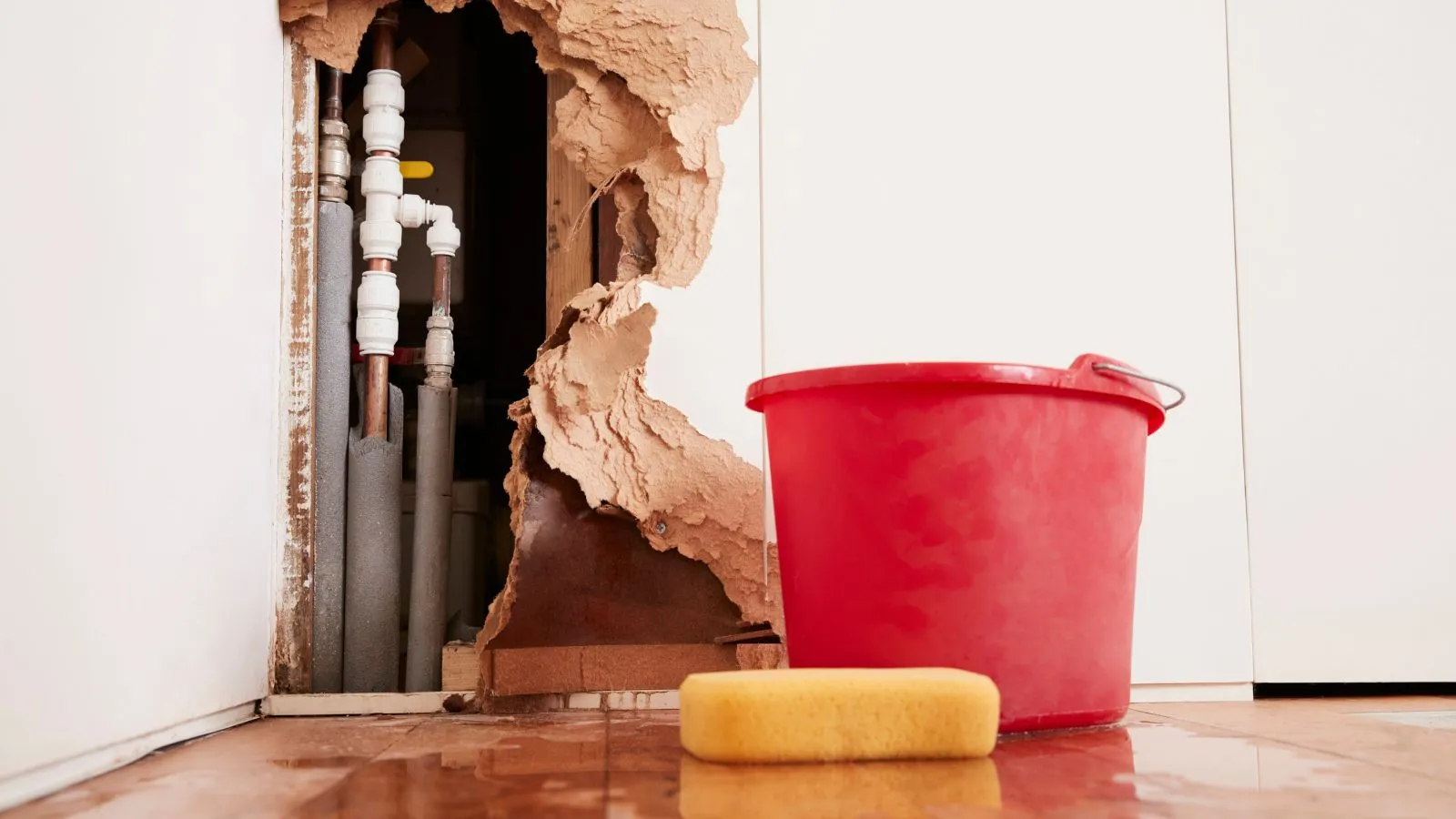
Burst pipe water damage is the damage caused when a supply line, fitting or pipe fails and releases pressurized water into a home. In Laguna Woods, CA, the pipes behind your walls and above your ceilings are often decades old, because the Village was built in phases between 1963 and 1985. A fitting that has served for forty years can split without warning, at any hour.
Our 24/7 line is (949) 670-0939. This page covers the failure itself: finding the source, stopping it, opening the cavity and dealing with the neighbors who may be wet too. If your main concern is bulk water on the floor, see emergency water removal.
How pipes fail in Laguna Woods homes
Freeze bursts are rare here, so most local failures are wear and corrosion. A supply line to a toilet or sink cracks, a threaded fitting weeps until it lets go, or a pinhole opens in a copper run. Any of these can run for hours before the stain shows.
Pipes inside walls and ceilings are the problem cases. Water follows the pipe and the framing, so the wet spot you see may be several feet from the break. In two-story buildings, the water from an upstairs failure often shows up first as a ceiling stain below.
What you see and what it means
A hissing or running sound in a wall
Water is moving where no fixture is open. The pipe is likely failing under pressure right now.
A growing ceiling stain or sag
Insulation and drywall are holding water. A sagging ceiling can drop without notice, so keep clear.
Warm, damp drywall or a musty smell
A hot water line may be leaking inside the cavity. Warmth and humidity speed up mold growth.
A water meter that keeps moving
With every fixture off, a moving meter dial points to a leak somewhere in the system.
Safety steps for the first hour
- Close the shut-off valve for the fixture first. It is usually under the sink or behind the toilet, and turns clockwise. If the leak is in a wall, close your unit's main valve, which is often found at the water heater, in a utility closet or at an outside wall.
- Do not touch outlets, switches or appliances near wet walls. If water reaches the electrical panel or you smell gas, leave and call 911. For a gas smell, also call SoCalGas.
- If you cannot find or turn your valve, call Village Resident Services at 949-597-4600 if you live in the Village, and ask your mutual who can shut off water to your building.
- Photograph the water, the wet walls and your belongings before you move anything. Lift small items to dry spots and keep children and pets away from wet floors.
- California's Department of Insurance advises making temporary repairs to prevent further damage and keeping receipts for what you spend.
What a failed pipe does inside a wall or ceiling
Water from a pressurized line moves in every direction at once. It runs down the cavity, soaks the bottom plate and insulation, and spreads along the back of the drywall. The surface may look nearly dry while the cavity is saturated.
In stacked buildings, it also travels through floor and ceiling assemblies into the unit below, and sideways into a shared wall. That is why a crew checks the neighboring walls and ceilings, not just yours.
Clean water or gray water: what category is it?
The ANSI/IICRC S500 standard for professional water damage restoration sorts water into categories. Water from a freshly failed supply line starts as Category 1, meaning clean. It can slip to Category 2 as it sits, picks up contact with dirty materials or stays wet for a long stretch.
A drain or waste line failure is different, because that water is contaminated from the start. Tell the dispatcher whether the pipe was a supply line or a drain.
| Source | Typical water category | What changes |
|---|---|---|
| Toilet or sink supply line | Category 1 at first | Fast extraction and drying usually save most materials |
| Hot or cold supply pipe in a wall | Category 1, can turn 2 | Wall cavity opened, insulation removed, framing dried |
| Pipe leaking for days | Often Category 2 | More porous materials removed, disinfecting step added |
| Drain or waste line | Category 2 or 3 | Protective gear and removal of soaked porous materials |
Water still coming from the wall?
Close the valve, then call the 24/7 line. A crew can be dispatched the same day when available.
How we find, open and dry the cavity
Confirm the source is off
The crew checks that the valve holds and the meter is still. A leak that is still active changes the plan.
Map the wet area
Moisture meters and a thermal camera show how far water has gone behind paint, tile and flooring.
Open the cavity
Small holes are cut in drywall or ceilings to release trapped water and expose wet insulation.
Extract and dry
Extraction wands pull standing water, then air movers and dehumidifiers dry the framing.
Verify and hand off
Readings are taken again until the materials match dry reference points. Pipe repair and rebuilding are separate trades.
Drying the cavity is what separates a quick fix from a lingering problem. Our approach to the drying stage is described under water mitigation. When the framing is dry, water damage repair replaces the drywall, texture and paint.
Neighbors and shared walls
If water has crossed into the next unit, tell your neighbor right away and knock on the door below you. Wet ceilings downstairs are easier to save when they are checked the same day. Document each unit separately with photos and notes.
Who pays for what depends on the cause and your building. Ask Resident Services and your mutual how a pipe failure in a shared wall is handled, because mutuals differ.
What changes the cost of burst pipe water damage
- How long the pipe ran. A pipe caught in minutes soaks far less than one that ran overnight.
- Which materials are wet. Drywall, insulation, flooring and cabinets each need different handling.
- Access to the cavity. A wall with tile or built-ins takes more work to open and close.
- Water category. Gray or contaminated water adds cleaning and removal steps.
- Units affected. Water that reached a neighbor widens the scope.
Want your real number? Call (949) 670-0939. Scope and price are explained before work starts.
How insurance fits a pipe failure
California's Department of Insurance says homeowners policies do not cover flood but do cover other kinds of water damage, and coverage depends on the cause. A burst pipe is usually a sudden event, while a slow drip over weeks is often treated differently. A flood policy covers outside water, not water from inside your home.
Condo and manor owners often hold a separate unit-owner policy. Check your policy, ask your insurer, and ask your mutual which damage falls to the association. We cannot promise how any claim will be decided.
Mistakes to avoid after a pipe fails
Do not wait to see if the stain stops, because the pipe will not heal itself. Do not paint or patch over a wet ceiling, which seals moisture in. Do not run a household vacuum on standing water.
Do not skip the plumber either. The restoration crew dries the structure, while a licensed plumber repairs the pipe. The City of Laguna Woods states that work valued at 500 dollars or more needs a CSLB-licensed contractor.
Laguna Woods facts that affect a pipe failure
According to the El Toro Water District, the district provides water service to Laguna Woods. Your water bill and meter belong to that system, so a leak between the meter and your building may involve the utility, while a leak inside your manor is yours or your mutual's to sort out.
According to the Laguna Woods Village community association, the Village was built in phases from 1963 to 1985 and has about 12,736 units. Many buildings share walls and floors, so a single failed pipe can reach several homes. Report leaks in manors to Resident Services at 949-597-4600.
The California Department of Insurance advises making temporary repairs to stop further damage and keeping the receipts. Shutting off the valve and drying the area counts as that kind of step, so save your records.
Source type: water district, community association and state insurance department
Neighbors outside the city get the same crews. We serve Laguna Hills and Aliso Viejo as well.
Burst pipe water damage service map for Laguna Woods
Common questions
Yes. The line is open 24/7, including nights, weekends and holidays. Same-day response is offered when crews are available.
It varies by building. Check near the water heater, in a utility closet, under the kitchen sink or at an outside wall. If you cannot find it, call Resident Services at 949-597-4600 if you live in the Village.
A licensed plumber repairs the pipe. A restoration crew finds the wet areas, extracts water and dries the structure. Both jobs usually happen in sequence.
Water from a supply line starts out clean, which the S500 standard calls Category 1. It can become Category 2 if it sits or touches dirty materials. Drain lines carry contaminated water from the start.
In stacked buildings, often yes. Water travels through floors, ceilings and shared walls. Tell your neighbor and your mutual as soon as you know.
Often yes. If moisture readings show a wet cavity, a small opening lets trapped water out and lets air movers dry the framing. A closed wall can stay wet and grow mold.